Astronomy News
2014
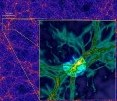 Distant
quasar shows up gross error in standard cosmological model Distant
quasar shows up gross error in standard cosmological model
Astronomers have discovered a distant quasar illuminating a vast nebula
of diffuse gas, containing far more normal matter than predicted by the
current cosmological model. Researchers at the University of California
led the study, published in Nature. 20 Jan 2014
2013
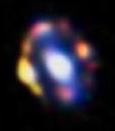 Remote
gravitational lens casts shadow over theory of galaxy evolution Remote
gravitational lens casts shadow over theory of galaxy evolution
The discovery of the most distant gravitational lens — a galaxy that
intensifies the light of an even more distant object — poses a mystery
that could challenge current ideas of how galaxies formed. 24 Nov 2013
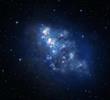 Astronomers
discover most distant known galaxy Astronomers
discover most distant known galaxy
A team of astronomers has
discovered a galaxy at a distance of 13.1 billion light years and a
redshift of 7.5, and it is surprisingly evolved for such a short time
after the big bang, posing problems for theorists. 23 Nov
2013
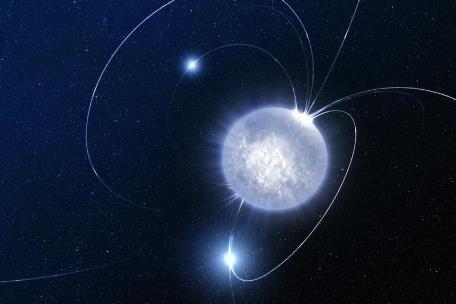 Super-bright supernovae may be powered by Magnetars Super-bright supernovae may be powered by Magnetars
New light has been shed on the rarest and brightest exploding stars ever
discovered in the universe. Research proposes that super-luminous supernovae are powered
by small and incredibly dense neutron stars called magnetars. 23 Nov
2013
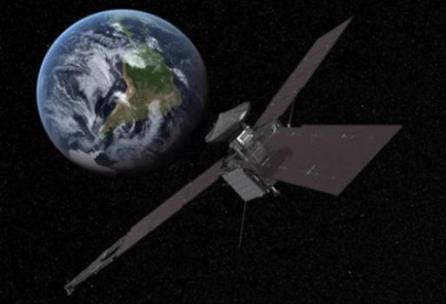 Hope
for astronomers stumped by 'flyby anomoly' Hope
for astronomers stumped by 'flyby anomoly'
A mystery that has
stumped scientists for decades might be one step closer to solution
after ESA tracking stations carefully recorded signals from the Juno
spacecraft as it swung by Earth. 23 Nov 2013
 Biggest structure in the universe challenges modern cosmology Biggest structure in the universe challenges modern cosmology
An international team of astronomers, led by academics from the
University of Central Lancashire, has found the largest known structure
in the universe. This large quasar group (LQG) is some 4 billion years
across and not predicted by modern theory. 7 Feb 2013
2012
Earliest spiral galaxy ever seen 'should not
exist'
Astronomers have discovered a spiral galaxy in the early
universe, billions of years before spiral galaxies should have formed.
Astronomers discovered it while studying the properties of about 300
very distant galaxies in the early universe using the Hubble Space
Telescope. 13 Dec 2012
 'Impossible' galactic arc threatens age of
universe 'Impossible' galactic arc threatens age of
universe
Astronomers using the Hubble Space Telescope have found
a puzzling arc of light behind an extremely massive cluster of galaxies
that are 10 billion light-years away. The trouble is an arc at that distance and age
shouldn't exist. 1 July 2012
 Neutron
star surface explosions captured in detail Neutron
star surface explosions captured in detail
In October 2010, a
neutron star near the centre of our galaxy erupted with hundreds of
X-ray bursts powered by a barrage of thermonuclear explosions on its
surface. NASA's Rossi X-ray Timing Explorer (RXTE) captured the
month-long display in extreme detail giving a unique insight into the
phenomenon. 23 May 2012
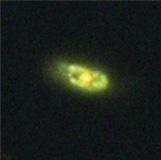 Missing
matter puzzle partially solved Missing
matter puzzle partially solved
When all the gas and dust
contained in ordinary galaxies like our own Milky Way is added up
astronomers cannot find nearly enough matter for stars to form at the
observed rates for long. As a partial solution, a matter cycle on
gigantic scales has been proposed. In the nearby universe, traces of
this mechanism had already been found. Now, a study in distant galaxies
confirms a key part of this galactic recycling process. 23 May 2012
2011
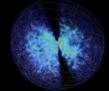 New
measurement of the Hubble constant New
measurement of the Hubble constant
A PhD student at the
University of Western Australia has produced one of the most accurate
measurements ever made of how fast the Universe is expanding using a new
method to calculate the Hubble constant. 8 August 2011
Void alternative to dark energy may be ruled
out
Astronomers using data from the Hubble Space Telescope may
have ruled out one alternative theory to dark energy after recalculating
the expansion rate of the universe to unprecedented accuracy. 10 July
2011
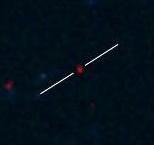 Gamma-ray
burst 'only 520 million years after big bang' Gamma-ray
burst 'only 520 million years after big bang'
A cosmic explosion
first detected in April 2009
is a candidate for the most distant object in the universe. At an
estimated 13.14 billion light years, it lies far beyond any known quasar
and could be more distant than any previously known galaxy or gamma-ray
burst. 10 July 2011
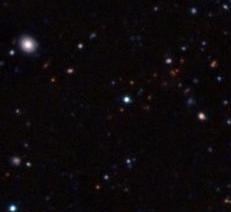 Galaxy cluster in 'early' universe is unexpectedly mature Galaxy cluster in 'early' universe is unexpectedly mature
Astronomers using the Very Large Telescope in Chile have proved
that a galaxy cluster with ancient galaxies and stars existed a mere
three billion years after the big bang.
10 July 2011
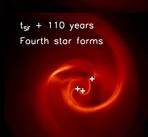 First
stars study contradicts big bang First
stars study contradicts big bang
Contrary to current thinking by
big bang theorists, the first stars in the universe were not all
solitary and massive. Rather, they probably formed alongside numerous
companions when the gas disks that surrounded them broke up during
formation, giving birth to sibling stars of various masses in the
fragments. 25 March 2011
 Predictions
at fault over time of massive galaxy formation Predictions
at fault over time of massive galaxy formation
The most massive
galaxies may have formed billions of years earlier than current
scientific models predict, according to surprising new research. The
results appear to disagree with the latest predictions of galaxy
formation and evolution. 3 January 2011
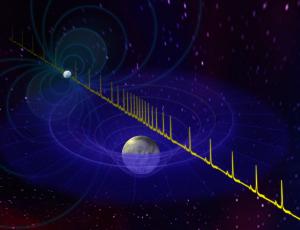 Discovery
of massive neutron star challenges theories of super-dense matter Discovery
of massive neutron star challenges theories of super-dense matter
Astronomers of the US National Radio Astronomy Observatory (NRAO)
have discovered the most massive neutron star ever seen. This discovery,
made using the Green Bank Radio Telescope in West Virginia, has strong
and wide-ranging implications across several fields of physics and
astrophysics. 3 January 2011
2010
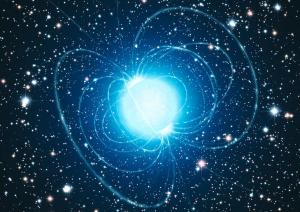 New
challenge to theory of black hole formation New
challenge to theory of black hole formation
Astronomers from
Europe , using the Very Large Telescope in Chile, have for the first
time demonstrated that a magnetar — an unusual type of neutron star —
was formed from a star that started its life with at least 40 times as
much mass as the Sun. 27 October 2010
Pulsar eclipses reveal clues to ultra-dense
matter
The first fast X-ray pulsar to be eclipsed by a companion
star has been discovered by astronomers using NASA's Rossi X-ray Timing
Explorer (RXTE). Future studies of this unique stellar system will shed
light on some of the most compressed matter in the universe and test a
key prediction of Einstein's relativity theory. 8 Sept 2010
Most distant galaxy cluster resembles those in
nearby universe
A team of astronomers, using the Spitzer Space
Telescope, has uncovered what may be the most distant cluster of
galaxies ever detected. However, it’s not the size nor the age of the
cluster that amazes the team of researchers. Rather, it’s the
surprisingly modern appearance of CLG J02182-05102 that has them
baffled. 24 June 2010
Latest supernova surveys fail to resolve
problems with dark energy
An international consortium called The
Supernova Cosmology Project has announced what it calls the 'Union2'
compilation of hundreds of supernovae type 1a, the largest collection
ever of high-quality data from numerous surveys that are searching for
and studying this particular type of stellar explosion. 24 June 2010
 Merging
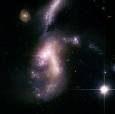
galaxies pose challenge to concept of evolving universe Merging
galaxies pose challenge to concept of evolving universe
New
images by NASA's Hubble Space Telescope show a group of small, ancient
galaxies are just beginning the long process of merging together to form
a large elliptical galaxy. Astronomers expect such encounters to only
occur very early on in a universe that is evolving from an explosive
beginning. 15 March 2010
Too few galaxies in early Universe
Five
international teams of astronomers studying data from Hubble's new
infrared camera, the Wide Field Camera 3 (WFC3) have unexpectedly found
that the density of galaxies in space decreases with distance. 15 March
2010
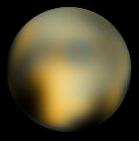 Remarkable changes on Pluto witnessed by Hubble Remarkable changes on Pluto witnessed by Hubble
NASA has released dramatic pictures taken with the Hubble Space
Telescope that show differences over a two-year period. Astronomers were
not expecting to find such obvious alterations to the surface structure
over so short a period compared to its orbital period of 248 years. 15 March
2010
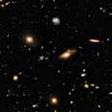 Deepest Hubble image surprises astronomers Deepest Hubble image surprises astronomers
The Hubble Space Telescope has made the deepest image of the
universe ever by using near-infrared light. The light from the furthest
objects in the image has taken an incredible 13.1 billion years to reach
us, a mere 600 million years after the Big Bang. 15 Feb 2010
Millions of hours of expensive supercomputer time used to prop up
big
bang model.
By making computer simulations of cosmic explosions big enough and frequent enough it was
possible to generate galaxies with substantially
lower densities at their cores, closely matching the observed properties
of dwarf galaxies. 12 Feb 2010
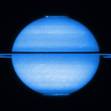 Hubble captures stunning images of double
aurora on Saturn. Hubble captures stunning images of double
aurora on Saturn.
Stunning new images taken by the Hubble space telescope have given a
once in a lifetime view of the fluttering aurorae that light up both of
Saturn's poles. The observations have allowed researchers to monitor the behaviour of
both Saturn's poles in the same shot over a sustained period of time. 12 Feb 2010
New views of Orion Nebula
New images taken by the world's largest infrared telescope have
revealed new details of the Orion Nebula. The images taken by the
European Southern Observatory's new VISTA survey telescope reveal many
of its hidden secrets.
 Furthest stellar mass black hole ever found Furthest stellar mass black hole ever found
Astronomers have detected a stellar-mass black hole much farther away
than any other previously known — 6 million light years. With a mass
above fifteen times that of the Sun, this is also the second most
massive stellar-mass black hole ever found. 12 Feb 2010
2009
Go out and see Comet Lulin!
Comet Lulin is currently moving past the bright star Spica in Virgo and
is just about visible with the unaided eye from a dark-sky site. Its
brightness will peak on 24 February. 17 February 2009
Cosmologists simulate early universe
Scientists have used a computer simulation to predict what the very
early Universe could have appeared like 500 million years after a big
bang.
The images, produced by scientists at Durham University’s Institute for
Computational Cosmology, show the formation of the first big galaxies in
the Universe. 12 February 2009
Astronomers discover cosmic dust fountain
Astronomers at the University of Toledo have observed a double-star
system that displays all the characteristics that astronomers suspect
are associated with dust production. 12 Feb 2009
NASA's great observatories celebrate
International Year of Astronomy
In conjunction with Galileo's birthday on Feb. 15, NASA is releasing
images from its Great Observatories — the Hubble Space Telescope,
Spitzer Space Telescope, and Chandra X-ray Observatory — to more than
100 planetariums, museums, nature centres, and schools across the US. 12
February 2009
to top
|